Double-Wall Vacuum Insulation: How It Works and What Buyers Should Know
When buying an insulated bottle, it is easy to focus on the words “304 stainless steel” or “24-hour insulation.”
But neither tells the full story.
A good vacuum-insulated bottle is a combination of the stainless steel body, the vacuum between the walls, the lid, the sealing system, and the way the product is made.
Understanding a few basics can help buyers compare drinkware suppliers more accurately—and avoid comparing products by price alone.
What Is Double-Wall Vacuum Insulation?
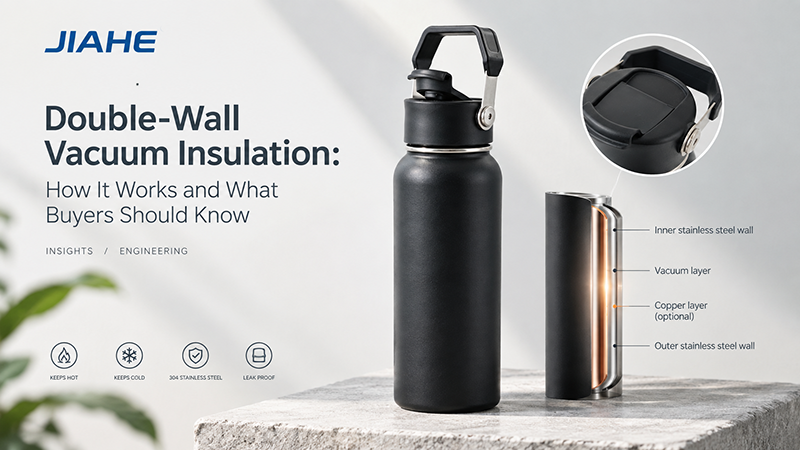
A double-wall vacuum bottle has two walls: an inner wall that holds the beverage and an outer wall that forms the outside of the bottle.
The air between these two walls is removed to create a vacuum.
Why remove the air?
Because air is one of the ways heat moves from one place to another. With most of the air removed, heat transfer between the inner and outer walls is greatly reduced.
This is the basic idea behind vacuum insulation, which is widely used in stainless steel water bottles, sports bottles, tumblers, and travel drinkware.
But there is more to insulation than simply creating a vacuum.
How Does a Vacuum Bottle Control Heat?
There are three basic ways heat can move:
Conduction
Conduction is heat moving through a material.
The vacuum space between the two stainless steel walls greatly reduces the amount of material available to transfer heat between the inside and outside of the bottle.
Convection
Convection is heat transfer caused by moving air or liquid.
Because most of the air has been removed from the space between the walls, there is very little air available to circulate. This greatly reduces convection in the vacuum space.
Radiation
Radiation is different. Heat can travel as thermal radiation, including infrared energy, even when there is very little air.
This is where a copper layer can play a role.
A reflective copper layer helps reflect thermal radiation and reduces this type of heat transfer. In other words, the vacuum and the copper layer are not doing the same job—they work on different parts of the heat-transfer process.
That distinction is useful when comparing different vacuum bottle constructions.
Does a Copper Layer Make a Difference?
Yes, and it is one of the options buyers can consider when developing an insulated drinkware product.
Based on the product construction and test conditions, a standard vacuum-insulated construction without a copper layer may provide around 6–12 hours of insulation. A construction with a copper layer may reach approximately 12–24 hours.
Adding the copper layer also increases the product cost.
For a promotional bottle or everyday drinkware product, the standard construction may provide a good balance between performance and price. For a premium product where longer temperature retention is an important selling point, the copper option may be worth considering.
This is why there is no single insulation specification that is right for every customer.
For OEM and ODM projects, the insulation construction can be discussed according to the product's target market, expected performance, and budget.
Actual performance depends on the complete product construction and test conditions.
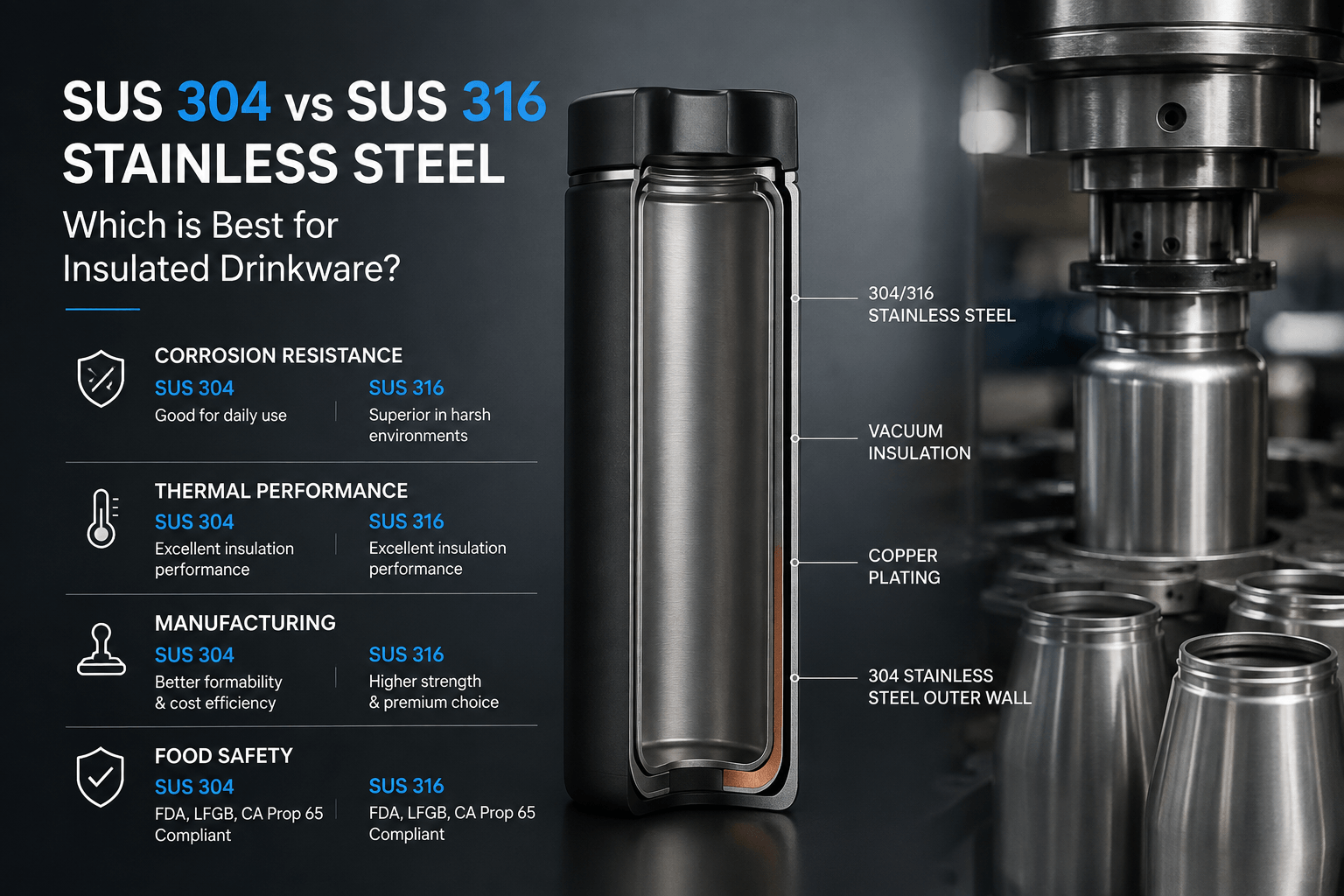
Is 304 Stainless Steel Enough?
304 stainless steel is widely used for insulated drinkware and is a practical material for many bottles and tumblers.
However, 304 stainless steel alone does not determine insulation performance.
When comparing two vacuum-insulated bottles, buyers should also look at:
· Inner and outer wall construction
· Vacuum quality
· Whether a copper layer is included
· Lid structure and thickness
· Gasket and sealing design
· Manufacturing consistency
· Test conditions
This is one reason two bottles that look almost identical can have different prices.
A lower quotation may come with a different insulation construction, lid specification, material configuration, or production requirement.
The product specification should always be compared before comparing the price.
Why Does the Lid Matter?
The lid is sometimes treated as a separate accessory. For an insulated bottle, it is really part of the overall system.
The top of the bottle is another path through which heat can enter or escape.
Lid thickness, internal structure, drinking openings, gasket design, and sealing all affect the finished product.
This becomes especially important for sports bottles with drinking spouts, straws, or dual drinking functions. Adding more openings or changing the lid structure may affect both usability and thermal performance.
For OEM and ODM projects, the bottle body and lid should therefore be considered together from the beginning.
What About Vacuum Quality?
A good stainless steel body is not enough if the vacuum is not maintained properly.
Loss of vacuum can have a direct effect on insulation performance. This makes vacuum quality an important production control point.
The vacuum process takes place during production, followed by quality checks on the finished product. At JIAHE, insulation performance is checked through production sampling, together with other key quality checks.
Leak testing and dimensional inspection are also carried out at different stages. For example, water-filled products can be checked in an inverted position, including a 45-degree test position, according to the production stage and product requirements.
For buyers, the key question is not simply whether a supplier says “vacuum insulated.” It is whether the supplier has a clear product specification and a quality-control process behind that claim.
How Should Buyers Compare Insulated Drinkware?
Before placing an OEM or ODM order, ask a few straightforward questions:
What stainless steel is used for the inner and outer walls?
Does the product include a copper layer?
What insulation performance is expected from this construction?
How is vacuum quality controlled?
How is the insulation performance tested?
Does the lid design affect the performance or cost?
Will a higher insulation requirement change the MOQ or price?
Getting these details clear before approving the sample can save time and avoid surprises during mass production.
The Bottom Line
A high-performing vacuum-insulated bottle is not simply a matter of using 304 stainless steel.
The vacuum reduces heat transfer through conduction and convection. A reflective copper layer helps reduce radiant heat transfer. The lid and sealing system affect heat loss through the top. And consistent production is what brings the whole design together.
For some drinkware projects, a standard vacuum construction is the right balance of performance and cost. For others, adding a copper layer makes sense when stronger thermal retention is part of the product's selling point.
The right specification is not necessarily the most expensive one.
It is the one that matches the product you want to sell.
At JIAHE, we work with brands, wholesalers, gift companies, and other drinkware buyers to develop insulated bottles and tumblers around their required materials, structure, performance, appearance, packaging, and target cost.
FAQ
What is double-wall vacuum insulation?
It is a bottle construction with two walls and a vacuum between them. The vacuum greatly reduces heat transfer between the beverage and the outside environment.
What is the purpose of a copper layer?
The vacuum mainly reduces conduction and convection. A reflective copper layer helps reduce heat transfer caused by thermal radiation.
How long can a vacuum-insulated bottle keep drinks hot or cold?
It depends on the construction and test conditions. As a general reference, a standard construction may provide around 6–12 hours of insulation, while a copper-layer construction may reach approximately 12–24 hours.
Does the lid affect insulation performance?
Yes. The lid is part of the overall insulation system. Its thickness, structure, drinking openings, gasket, and sealing can all affect the final performance.
What should I ask a drinkware manufacturer before ordering?
Ask about the stainless steel specification, vacuum construction, copper layer, expected insulation performance, testing method, lid design, MOQ, and how changes to the specification will affect the final cost.